


-
Buy our wine
 Free shipping in France on orders over €200
 - Our wines and crémants
- Sustainable Winegrowing
- Discover us
- News


 English
Riesling ou Gewurztraminer : comment choisir entre ces deux cépages alsaciens ?
Riesling and Gewürztraminer represent two distinct expressions of the Alsatian vineyards. The former stands out for its freshness and minerality, while the latter is characterized by its aromatic intensity and roundness. Two styles, two personalities, two approaches to tasting.
At Bestheim, these two grape varieties play a central role in our wine selections. Each reveals the Alsatian terroirs in its own way, from vineyard wines to Grands Crus. The choice between the two depends on your current preferences, the dish you’d like to pair it with, and the flavor profile you’re looking for.
Understanding their differences will help you better identify which one meets your expectations.
How do you choose between Riesling and Gewürztraminer?
The choice between these two grape varieties comes down to a few simple criteria: the flavor profile you’re looking for, the food pairings you have in mind, and the occasion for drinking.
What you’re looking for on the palate:
If you enjoy fresh, lively wines, opt for Riesling.
Freshness, in concrete terms, is that sensation of liveliness that awakens the palate, carried by pronounced acidity. Bestheim’s Riesling is vinified dry: no sweet roundness, but a mineral tension that gives it a lively edge on the palate. If sweet or semi-sweet wines don’t appeal to you, this is the one to choose. It pairs perfectly with a meal from start to finish without ever becoming cloying.
If you’re looking for aromatic intensity and roundness, turn to the Gewurztraminer.
Our Gewurztraminers range from off-dry to sweet. This roundness translates to fullness on the palate, with residual sugars that balance the grape variety’s aromatic power. Do you enjoy full-bodied, expressive wines with a touch of sweetness? Gewurztraminer is the perfect choice for you. For those seeking distinctly sweet and concentrated wines, our Vendanges Tardives or Sélection de Grains Nobles cuvées offer even greater richness.
Food and wine pairings:
- Riesling: fish, seafood, light dishes
- Gewurztraminer: spicy dishes, bold cheeses, dishes with pronounced flavors
Best served:
- Riesling: a lively aperitif, enjoyed throughout the meal
- Gewurztraminer: aromatic aperitif, hearty main course, end of the meal
These two grape varieties complement each other rather than contrast. Each reveals a facet of the Alsatian terroir, with distinct styles that are always rooted in our vision of wine. Discover our complete guide to choosing your Bestheim Gewurztraminer!

Riesling and Gewürztraminer: Two Expressions of the Alsatian Terroir
Understanding the history and significance of these two grape varieties in Alsace provides a better understanding of their identity.
Key points:
- Two of Alsace’s four noble grape varieties, authorized for use in Grand Cru wines
- Riesling: cultivated since Roman times, a late-ripening variety, accounts for 23% of Alsace’s vineyards
- Gewurztraminer: introduced in the 16th century, an early-ripening variety grown on hillsides
- At Bestheim: Riesling expresses mineral purity, while Gewurztraminer conveys aromatic intensity
At Bestheim, these two grape varieties form the backbone of our range, from vineyard wines to Grands Crus. Riesling reveals the purity and minerality of Alsatian terroirs through dry, elegant wines. Our Grands Crus, such as the Schlossberg ( granitic soil) and the Mambourg ( limestone soil), exemplify this diversity. Gewurztraminer embodies a different approach: we highlight its aromatic intensity and roundness to create wines that are enjoyable, expressive, and generous. The Zinnkoepflé Grand Cru, thanks to its unique altitude, offers particularly pronounced complexity. These two styles complement each other and allow our cooperative winemakers to showcase the diversity of the terroirs we cultivate.


The Aromatic Profiles of Riesling and Gewürztraminer at Bestheim
These two grape varieties are distinguished by radically different aromatic profiles. Riesling expresses purity and freshness, while Gewürztraminer expresses intensity and richness; each cuvée reveals a facet of these characteristics.
Riesling: Freshness and Minerality
Riesling is recognizable by its aromatic clarity and finesse.
Riesling is characterized by its aromatic clarity and finesse. Our cuvées offer a lively and approachable profile, perfect for discovering Riesling:
- Riesling Chasseurs de Lune: bright citrus (lemon, orange zest) and white flowers
- Riesling Rayon de Lune: dominant grapefruit and pronounced minerality, a gastronomic expression
Our Grand Crus reveal the minerality and finesse of exceptional terroirs, with a structure that allows them to age gracefully:
- Grand Cru Schlossberg: delicate floral notes, pears, rhubarb, and exceptional minerality derived from the granite soil
- Grand Cru Mambourg: intense citrus and floral nuances (acacia blossom), carried by the power of the limestone terroir
Our exceptional cuvées combine richness and freshness, exploring Riesling beyond the dry style:
- Riesling Exception: red and yellow fruits, vanilla notes, and an elegant mineral finish
- Riesling Vendanges Tardives: candied fruits (apricot, pineapple), acacia honey, candied lemons, where the grape variety’s freshness balances the richness
Gewürztraminer: Intensity and Full-Bodiedness
Gewurztraminer makes an immediate aromatic impression. Its profile is built around exotic and spicy notes, with a fullness on the palate that clearly distinguishes it from Riesling.
Our single-vineyard Gewurztraminer cuvées offer rich, indulgent aromas, ideal for discovering the full potential of this grape variety:
- Gewurztraminer Chasseurs de Lune: lychee, exotic fruits (pineapple), sweet spices.
- Gewurztraminer Rayon de Lune: mango, lychee, pineapple, a hint of rose, and spicy notes, with a delicate roundness.
Our Grand Crus reveal the full complexity of the grape variety on unique terroirs:
- Gewurztraminer Grand Cru Mambourg: fruit, flowers, and spices; an opulent expression from a limestone terroir, “Gewurztraminer soil.”
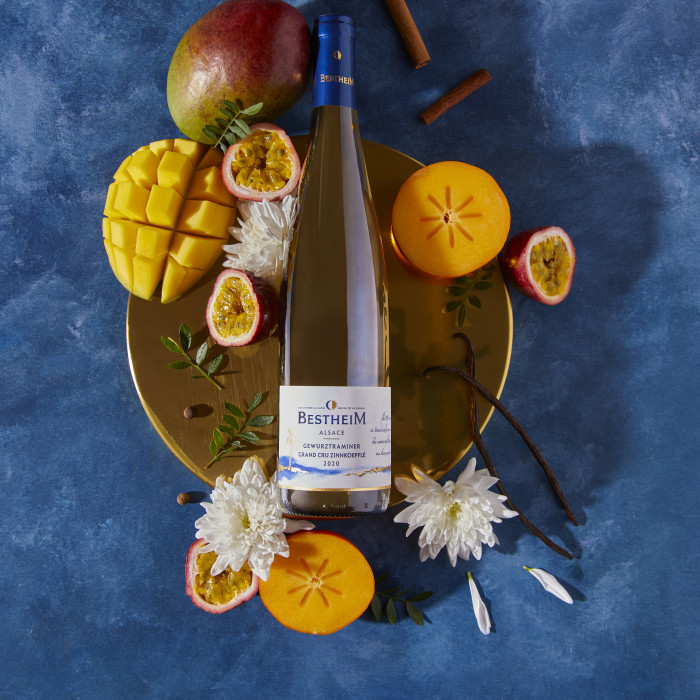
- Gewurztraminer Grand Cru Zinnkoepflé: pronounced spices, mango, a finish of honey and pepper, complexity derived from the altitude and the unique Mediterranean microclimate.
Our prestige cuvées are reserved for special occasions, featuring intense and rare wines:
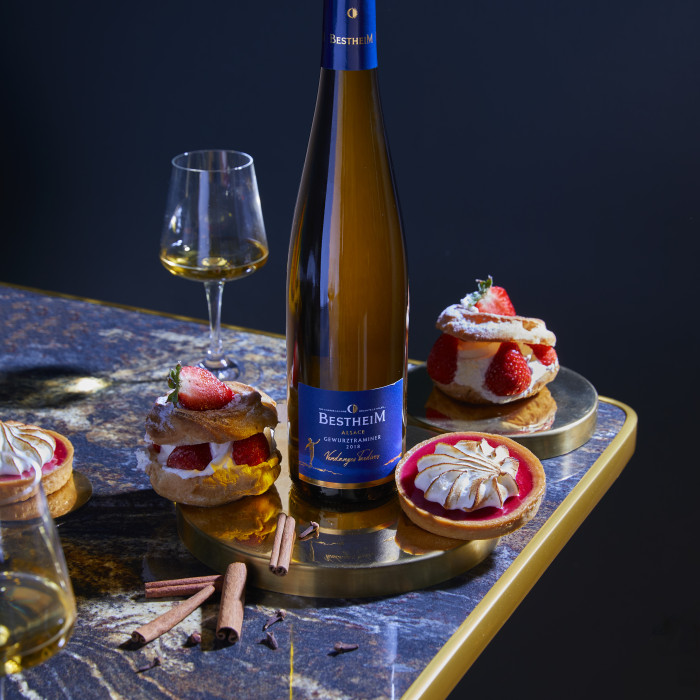
- Gewurztraminer Vendanges Tardives: candied apricot, candied fruits, spices, with a finish of raisins.
- Gewurztraminer Sélection de Grains Nobles: rose, exotic and candied fruits (mirabelle plum, yellow peach), vanilla, caramel, honey, exceptional power and complexity.
Now that you’ve explored the Bestheim range centered on Riesling and Gewurztraminer, how do you choose between these two wines depending on the main course, dessert, or aperitif?
Which wines pair best with my dish?
The choice between Riesling and Gewurztraminer depends largely on the dish you wish to pair it with. The simple rule: the more pronounced, spicy, or rich the flavors of the dish, the better Gewurztraminer pairs with it. Conversely, for light, delicate, or seafood-based dishes, Riesling is the natural choice. To learn more: check out our comprehensive guide on what to eat with Gewurztraminer.
Here’s how to make your choice:
With a Gewurztraminer:
- Asian and Middle Eastern cuisine (Thai, Indian, and tagine dishes)
- Spicy dishes and boldly seasoned dishes
- Strong, full-flavored cheeses (Munster, Roquefort)
- Foie gras (check out all our pairing tips for foie gras)
- Rich desserts and pastries
Pair with a Riesling:
- Fine fish and seafood
- Shellfish and Japanese cuisine
- Alsatian sauerkraut (check out our suggestions for Alsatian wines to pair with sauerkraut)
- Light dishes and delicate cuisine
- Goat cheeses
- Light fruit desserts (paired with Riesling Vendanges Tardives)


