


-
Buy our wine
Free shipping in France on orders over €200
- Our wines and crémants
- Sustainable Winegrowing
- Discover us
- News


 English

Pinot Noir: In which regions is it grown?
Pinot Noir is grown on every continent, but it never expresses itself in the same way. Each region, each terroir, and each climate shapes a different wine. Native to Burgundy, Pinot Noir has spread far beyond its historic birthplace. It can be found in Champagne, Alsace, the Loire Valley, Germany, New Zealand, and Oregon. Everywhere, it remains a demanding grape variety that reflects the soil in which it grows. One grape variety, dozens of profiles.
Burgundy: The Historic Birthplace of Pinot Noir
Pinot Noir has been grown in Burgundy since the Middle Ages. It is native to this region, just as Riesling and Gewürztraminer are native to Alsace. The limestone and clay-limestone soils of the Côte d'Or give it the complexity that the whole world seeks to replicate.
The Burgundian appellation system (Village, Premier Cru, Grand Cru) reflects the diversity of its terroirs, from the Côte de Nuits to the Côte de Beaune.
Typical Burgundy profile: delicate red fruit when young, followed by notes of forest floor, truffle, and spices with age. These wines gain in complexity over the years.
Alsace: The Region’s Only Red Grape Variety
In Alsace, Pinot Noir holds a unique place. It is the only grape variety and red wine authorized in the region. Today, it accounts for 10% of Alsace’s vineyards, a steady increase driven by winemakers committed to quality.
Long considered a secondary variety, Alsatian Pinot Noir is experiencing a true renaissance. The limestone and marl-limestone terroirs, combined with a continental climate (hot summers, dry autumns), allow Pinot Noir to reach optimal ripeness while preserving its freshness. The result: fruity wines with silky tannins, approachable in their youth, yet capable of developing structure in the finest cuvées.
Starting with the 2022 vintage, Pinot Noir has been officially authorized in Alsace Grand Cru for the Hengst and Kirchberg de Barr appellations. Le Vorbourg, in Rouffach, followed suit with the 2024 vintage. Three Alsatian Grand Crus now open to Pinot Noir—a recognition that confirms the variety’s potential on the region’s terroirs.
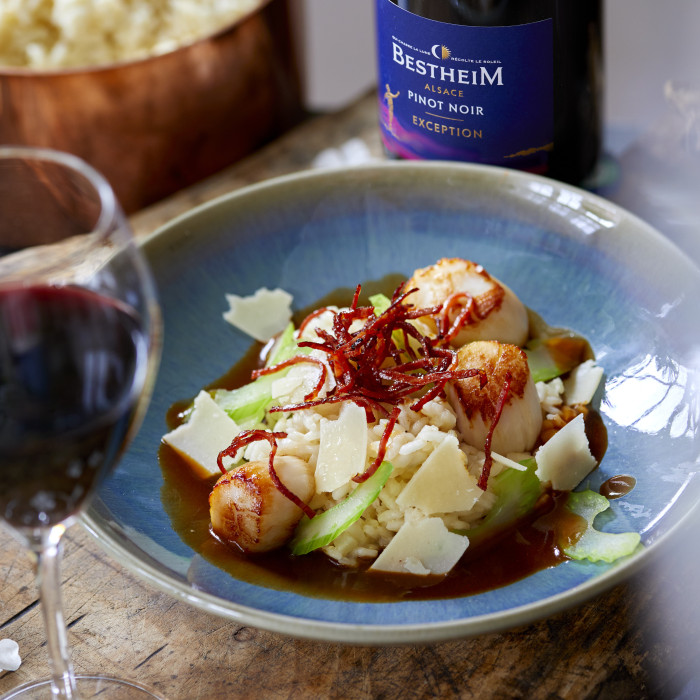
At Bestheim, Pinot Noir is available in four still red wines, ranging from the fruity and approachable Chasseurs de Lune to L’Impatient, a rare cuvée of 3,000 bottles sourced from the Vorbourg Grand Cru. Pinot Noir is also a component of our Crémants d’Alsace Rosé, where it brings freshness and aromas of red berries.
Alsatian Pinot Noir does not imitate Burgundy. It has its own identity, its own balance between fruit and structure.

Champagne: Pinot Noir in a Sparkling Form
Pinot Noir is one of the three main grape varieties used in Champagne, alongside Chardonnay and Pinot Meunier. It contributes structure, body, and red fruit aromas to Champagne blends. In Alsace, Pinot Noir plays a similar role in our Crémant Rosés.
When vinified without maceration, it yields blanc de noirs: white Champagnes made exclusively from black grapes. With a short maceration period, it produces rosé Champagnes. A red grape variety used to create sparkling wines.
In Alsace, Pinot Noir follows the same principle. Our Crémants d’Alsace Rosé are produced using the traditional method, with a second fermentation in the bottle, identical to the method used in Champagne.
Loire, Jura, and Other French Regions
Outside of Burgundy, Pinot Noir thrives in several French regions:
- Loire (red Sancerre, Touraine): light and fruity, with low levels of tannins, limestone and flint soils.
- Jura: fresh and understated cuvées, continental climate, often blended.
- Languedoc, Southwest: more niche, with sunny and fruity expressions.
These wines are more understated than those of Burgundy, but they highlight the grape variety’s versatility on cool terroirs.
Pinot Noir Around the World
Pinot Noir has spread far beyond France. It thrives wherever a cool to temperate climate allows:
- Germany (Spätburgunder): the most widely planted red grape variety, in Baden and the Palatinate, producing increasingly structured wines.
- New Zealand (Central Otago, Marlborough): lively acidity, intense red fruit flavors, and a rapidly growing reputation.
- United States (Oregon): cool climate, refined and elegant Pinot Noir.
- United States (California): sunnier climate, rich and full-bodied wines.
- Australia (Yarra Valley, Tasmania): cool climates, refined and delicate profiles.
- South Africa (Walker Bay): emerging terroir, promising profiles.
- Italy (Pinot Nero, Alto Adige): alpine soils, freshness, finesse.
One thing remains constant everywhere: Pinot Noir reveals its soil like no other grape variety.
Is Pinot Noir a grape variety from Alsace or Burgundy?
Both. Pinot Noir originates from Burgundy, where it has been grown for centuries. But it is also the only red grape variety authorized in Alsace, where it produces wines with a different profile: fruitier, with silky tannins, and often more approachable. At Bestheim, our Exception exemplifies this rise in quality of Alsatian Pinot Noir.


