


-
Buy our wine
Free shipping in France on orders over €200
- Our wines and crémants
- Sustainable Winegrowing
- Discover us
- News


 English
Why do wine bottles have shapes?
You have probably noticed that wine bottles do not all have the same shape. Why are there so many different shapes for French wine bottles?
We explore this topic in this episodeof EXTRA BRUT, oureducational web series about wine, with food and wine critic Nicolas Rieffel. The goal: to answer in record time all the questions you've ever asked yourself about wine...
Answers provided by the "Chasseurs de Lune" (Moon Hunters), members and employees of the Bestheim winery.
The origins of different wine bottle shapes: tradition and regulations!
The glass bottle is an innovation that became widespread in the 18th century. Its use became standard when it was realized that wine kept better in bottles than in barrels! Its capacity was quickly set at 75 cl. However, the shape of the bottle varied: rounded, slender, more square, more curved... Here is a quick tour of France's wine bottles!
The Burgundy
Pot-bellied, tall, with soft shoulders and a thin neck, and a slightly conical body, it appeared in Burgundy at the end of the 17th century and is now found all over the world.
The Bordeaux
... also known as "frontignan"! This is the most popular bottle, and often the one we imagine when we think of a bottle of wine. Bordeaux bottles used to be cone-shaped, but as this was neither very practical nor very sturdy, they became cylindrical. It has been adopted in several other regions that do not have their own designated bottle!
The Loire
This is the famous bottle with a fleur-de-lis design. It resembles the Burgundy bottle, but is slimmer. The coat of arms of the Loire Valley is engraved on the Angevine, while the bottle used for Muscadets bears the name of the appellation at the bottom of the barrel.
The Provençale
There are two types of bottles for the Côtes de Provence appellation: wines from individual producers are bottled in "flûtes à corset" (with a narrower base), while négociants use the "Côte-de-Provence" bottle.
The Rhodanienne
This is the bottle used for Châteauneuf-du-Pape wines, with the "Côtes du Rhône" coat of arms engraved on the shoulder.
The Clavelin du Jura
This bottle is used exclusively for Jura's vin jaune. It has a smaller capacity than the others, only 62 cl.
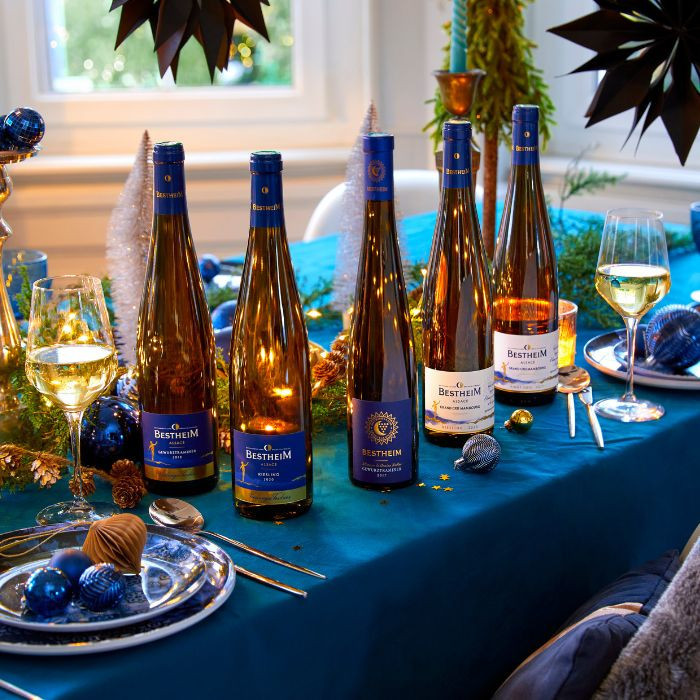
And finally, the Alsace Flute (or Rhine Flute)
Delicate and elegant, this is the tallest of the bottles, whose specific shape is even protected by a decree dating from 1955!according to regulations, it must consist of a straight, cylindrical body topped by an elongated neck approximately five times the diameter of the base. The cylindrical part must be approximately one-third of the total height.
The shape of these bottles has been exported all over France and around the world!
With these main characteristics, is it easy to identify where a wine comes from just by looking at the bottle? Yes and no, because the shape of the bottle is not a patent that prevents producers in other countries or regions from making similar bottles. The Bordeaux bottle can therefore be found in South Africa, Chile, the United States, Italy, Crete, Austria, and Hungary. The Rhine flute is used to bottle Cassis wine, as well as Crépy and Jurançon. Many wines from northern Italy, Germany, Austria, and Eastern Europe are also bottled in flutes.
Ultimately, only the Clavelin du Jura and the Flûte d'Alsace are subject to specific measurements in the specifications for the appellations concerned in order to bear their names. As for other shapes, such as Bordeaux and Burgundy bottles, there are no regulations! Winemakers are therefore free to choose any bottle shape for their wines.


While the shape of wine bottles was initially influenced by regional traditions, today it continues to convey an identity, a message, and sometimes even a style of tasting. Whether Burgundy, Bordeaux, or Alsace, each bottle tells a little of the story of the wine it contains. And while some shapes are strictly regulated, such as the Flûte d'Alsace and the Clavelin jurassien, most give free rein to the creativity of the winemakers. Next time you choose a bottle, take a good look at it... it says a lot, even before it's opened!


